Address
No.34 Weimin Road,Dongcheng District,Dongguan City,Guangdong Province,China
Whatsapp
+86 13829129089

Address
No.34 Weimin Road,Dongcheng District,Dongguan City,Guangdong Province,China
Whatsapp
+86 13829129089
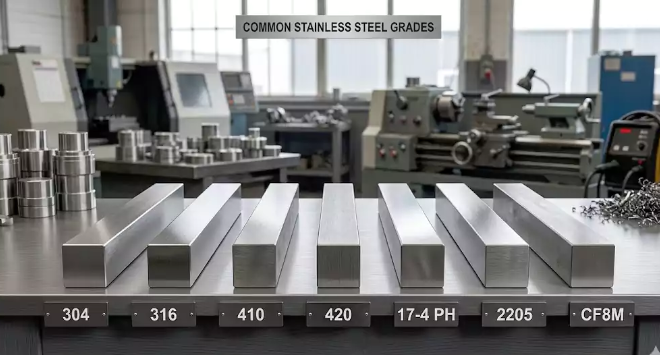
Pick the wrong grade and your part corrodes, cracks or costs too much to machine. This guide walks through the five families of stainless steel, the eight grades we see most in custom hardware, and which manufacturing process — forging, die casting, CNC or stamping — actually suits each one.
At Changye we work with stainless steel across all six of our in-house processes: forging, die casting, sheet metal, stamping, CNC turning/milling and wire EDM. That means when a customer sends a drawing for a non-standard part, we don’t just ask “what material?” — we ask “what material plus what process?” because the grade you pick changes which method makes sense, how much machining is needed, and whether the part can be produced at volume without scrap.
Experience note: We’ve seen projects where the customer specified 316 “just to be safe” — but the part was an indoor bracket that never sees chlorides. Switching to 304 cut material cost roughly 20% and machined faster, with zero functional sacrifice. The best grade is rarely the most expensive; it’s the one that matches your real operating conditions.
Stainless steels are grouped by their microstructure — the arrangement of crystals that forms when the alloy cools. Each family trades off corrosion resistance, strength, hardness, weldability and machinability in different ways. Here’s the landscape:
High chromium + high nickel. Best corrosion resistance and weldability. Non-magnetic. The workhorse family — 304 and 316 account for most custom hardware we process.
Chromium with very little nickel. Lower cost, moderate corrosion resistance, magnetic. Easier to machine than austenitic. Grades like 430 and 409 — good for decorative and exhaust hardware.
Designed for hardness and wear resistance. Can be heat-treated to high strength. Corrosion resistance is lower than 304/316. Ideal for shafts, blades, valve internals.
Mixed austenite + ferrite structure. Nearly twice the yield strength of 304 with excellent chloride stress-corrosion resistance. Allows thinner, lighter parts without sacrificing durability.
Ultra-high strength while keeping good corrosion resistance. Dimensionally stable after heat treatment. Used in aerospace brackets, precision gears, energy hardware.
Some grades cast beautifully but fight the CNC tool. Others machine like butter but crack in a forge. Here are the eight we quote most often, with the trade-offs that actually matter for custom hardware:
| Grade | Family | Corrosion Resistance | Strength | Machinability | Weldability | Best Process Fit |
|---|---|---|---|---|---|---|
| 304 | Austenitic | Excellent | Medium | Fair | Excellent | CNC, stamping, sheet metal |
| 316 | Austenitic | Superior (+Mo) | Medium | Fair | Excellent | CNC, die casting (CF8M equiv.) |
| CF8 | Austenitic (cast) | Excellent | Medium | Fair | Excellent | Die casting / investment casting |
| CF8M | Austenitic (cast) | Superior | Medium | Fair | Excellent | Die casting / investment casting |
| 410 | Martensitic | Medium | High | Good | Medium | Forging, CNC |
| 420 | Martensitic | Medium | Very High | Good | Limited | Forging, CNC, wire EDM |
| 2205 | Duplex | Excellent | Very High | Medium | Medium | Forging, CNC (careful weld control) |
| 17-4 PH | P-H | Good | Very High | Good | Good | CNC, forging, wire EDM |
A few practical notes from our shop floor:
The instinct to “just use 316 everywhere” is understandable but expensive. Here’s our decision framework, based on what the drawing and the operating environment actually require:
| What You Need | Recommended Grade | Reason |
|---|---|---|
| General corrosion resistance (indoor, no chlorides) | 304 | Best cost-to-performance ratio in the austenitic family |
| Marine, chemical, or chloride exposure | 316 | Molybdenum buys you service life that 304 can’t match |
| Strong chloride stress-corrosion cracking resistance | 2205 | Duplex structure resists cracking where austenitic grades fail |
| High hardness / wear resistance | 410, 420 | Martensitic grades are heat-treatable to high hardness |
| Very high strength + corrosion resistance | 17-4 PH, 2205 | P-H gives dimensional stability after heat treat; duplex gives yield strength |
| Best machinability (less tool wear, faster cycles) | 410, 420 | Martensitic machines easier than austenitic — shorter CNC time |
| Food / medical contact | 304, 316 | Clean surface finish + regulatory acceptance |
| Complex internal geometry (cast part) | CF8, CF8M | Casting equivalents of 304/316 — near-net shape, then CNC finish |
| Cost efficiency across the board | 304 | Material + machining + welding all cheaper; covers 70% of applications |
DFM tip from Changye: When you send us a drawing, we review not just the geometry but the grade-vs-process fit. If you’ve called out 316 for a part we can forge from 410 and then machine to spec, we’ll flag that — because 410 forgings are faster and cheaper, and the corrosion resistance of 410 may be perfectly adequate for an indoor shaft. The savings go straight to your unit cost.
At Changye, we don’t offer just one process — we offer six. That means the grade you pick determines not only the material cost but which manufacturing route gives the best quality-per-dollar:
Best for martensitic grades (410, 420) and duplex (2205). Produces dense, high-strength parts with favorable grain flow. Not ideal for austenitic 304/316 — they work-harden under the hammer, making post-forge machining harder.
Best for austenitic casting grades (CF8, CF8M) and some aluminum/zinc alloys. Gives near-net shape for complex internals. Martensitic grades don’t cast well — they crack on cooling.
Works for every grade, but machinability varies widely. 410/420 machine fast; 304/316 are gummy and wear tools; 17-4 PH is moderate after solution-annealing. Best for tight-tolerance features (±0.01mm) and low-to-medium volumes.
Grade-independent (any conductive stainless works). Solves the “impossible geometry” problem — thin slots, sharp internal corners, precision fits at ±0.005mm. Ideal when CNC can’t reach or the part is too thin to hold.
Best for austenitic grades (304, 316) and ferritic (430). Formability is key — martensitic and P-H grades resist bending and crack. Stamping 304 washers, clips and brackets is fast and cost-efficient at volume.
Real custom hardware often needs more than one process: CF8M casting + CNC finishing for valve bodies; 410 forging + CNC + wire EDM for complex shafts; 304 stamping + welding for enclosures. Changye runs all steps in-house, so there’s no inter-vendor delay.
Trust beats a re-run. A few boundaries we’re upfront about:
Changye is a non-standard OEM/ODM custom hardware and fastener manufacturer — forging, die casting, sheet metal, stamping, CNC and wire EDM all under one quality system. We’ll pick the right grade and the right process for your part.